Does Towing Capacity Include Tongue Weight Explained
Does towing capacity include tongue weight? The short answer is no — towing capacity and tongue weight are two separate numbers that every trailer owner needs to understand. Tongue weight is the downward force your trailer puts on your hitch, and it plays a big role in safe towing. Knowing the difference between these two values can keep you safe on the road and prevent costly damage.
You loaded up your trailer, hit the road, and everything seemed fine — until you noticed your vehicle swaying or struggling on an uphill grade. What went wrong? More often than not, the culprit is tongue weight. And the biggest confusion out there is whether does towing capacity include tongue weight. Let’s clear that up right now because getting this wrong can be dangerous.
Towing a trailer is not just about hooking up and driving. It involves understanding a whole set of numbers and limits. Tongue weight, trailer hitch specs, payload capacity, and gross vehicle weight rating all play a role. When you understand how these pieces fit together, towing becomes safer and a lot less stressful.
This guide breaks down everything you need to know about tongue weight and how it relates to your vehicle’s towing capacity. We will walk through the numbers, the common mistakes, and the practical steps you can take to tow with confidence. Whether you are pulling a small utility trailer or a large travel trailer, this article has you covered.
Key Takeaways
- Towing capacity and tongue weight are not the same thing. Towing capacity is the maximum weight your vehicle can pull, while tongue weight is the downward force on the hitch.
- Tongue weight should be 10-15% of your total trailer weight. This is the golden rule for safe and stable towing.
- Exceeding tongue weight limits can cause dangerous trailer sway. Too much or too little tongue weight makes your vehicle hard to control.
- Your vehicle’s payload capacity matters more than you think. Tongue weight counts toward your vehicle’s total payload, not just its towing limit.
- Weight distribution hitches help manage tongue weight. They spread the load across all axles for a safer, more balanced tow.
- Always check your vehicle’s owner manual for towing specs. Manufacturer guidelines are your most reliable source for towing limits.
- Use a tongue weight scale to measure accurately. Guessing leads to overloading and unsafe driving conditions.
📑 Table of Contents
What Is Tongue Weight and Why Does It Matter?
Defining Tongue Weight
Tongue weight is the downward force that the front of your trailer puts on your vehicle’s hitch ball. Think of it as the pressure that keeps your trailer connected and stable. Without the right amount of tongue weight, your trailer can fishtail, sway, or even detach from your vehicle — and none of those outcomes are good.
Here is a simple way to think about it. When you attach a trailer, the trailer’s coupler rests on the hitch ball. The weight pushing down on that ball is your tongue weight. It is a real, measurable force that affects how your vehicle handles. Too little tongue weight and the trailer will swing from side to side. Too much and you will overload the rear of your vehicle, making the front end light and hard to steer.
The Golden Rule of Tongue Weight
The widely accepted rule in the towing world is that tongue weight should be 10% to 15% of your total trailer weight. For example, if your fully loaded trailer weighs 5,000 pounds, your tongue weight should fall between 500 and 750 pounds. This range keeps your trailer stable and your vehicle balanced.
Why does this percentage matter so much? Because your vehicle is engineered to handle a specific amount of downward force at the rear axle. Exceeding that force changes how your car, truck, or SUV drives. It affects braking, turning, and even fuel efficiency. Staying within the recommended tongue weight range is one of the simplest things you can do for towing safety.
Why Tongue Weight Affects Vehicle Handling
Your vehicle has a specific weight distribution across all four wheels. When you add a trailer, that distribution changes. The tongue weight shifts more load to the rear axle and reduces the load on the front axle. This has real consequences:
- Too little tongue weight (under 10%): The trailer becomes unstable. It may sway with crosswinds or when you pass a large truck. This is called trailer sway, and it can lead to jackknifing or loss of control.
- Too much tongue weight (over 15%): The rear of your vehicle sags. This reduces headlight alignment, strains the rear suspension, and makes the front wheels less effective for steering and braking.
- Just the right tongue weight (10-15%): Your vehicle tracks straight, brakes evenly, and handles turns smoothly. The trailer follows your vehicle predictably.
How Towing Capacity Works
What Towing Capacity Actually Means
Towing capacity is the maximum weight your vehicle can safely pull behind it. This number is set by the manufacturer based on your vehicle’s engine, transmission, brakes, suspension, and frame strength. You can usually find this number on a label inside the driver’s door jamb or in your owner’s manual.
It is important to understand that towing capacity refers to the weight of the trailer itself, plus everything inside it — cargo, gear, food, water, and anything else you are hauling. It does not refer to the tongue weight separately. The towing capacity is the total trailer weight your vehicle is rated to pull.
Key Towing Terms You Need to Know
The world of towing has a lot of acronyms and technical terms. Here are the ones that matter most for understanding does towing capacity include tongue weight:
- Gross Vehicle Weight Rating (GVWR): The maximum total weight of your vehicle plus passengers, cargo, and tongue weight. This is a hard limit set by the manufacturer.
- Gross Combined Weight Rating (GCWR): The maximum combined weight of your vehicle plus the fully loaded trailer. This number covers both the tow and the payload.
- Payload Capacity: The maximum weight your vehicle can carry, including passengers, cargo, and tongue weight. This is different from towing capacity.
- Hitch Weight: Another term for tongue weight. It is the downward force the trailer exerts on the hitch ball.
- Trailer Weight Capacity: The maximum weight a trailer is designed to carry, separate from your vehicle’s towing ability.
The Difference Between Towing Capacity and Payload Capacity
This is where many people get confused. Towing capacity is about pulling. Payload capacity is about carrying. Your tongue weight counts against your payload capacity, not your towing capacity.
Here is an example to make this clear. Say your truck has a towing capacity of 10,000 pounds and a payload capacity of 2,000 pounds. You attach a trailer that weighs 8,000 pounds fully loaded. Your tongue weight is 800 pounds (10% of 8,000). That 800 pounds comes out of your 2,000-pound payload capacity. So you only have 1,200 pounds left for passengers and cargo inside your truck.
This is why people sometimes overload their vehicles without realizing it. They check the towing number but forget about payload. And tongue weight is a big part of that payload equation.
Does Towing Capacity Include Tongue Weight?
The Direct Answer
Here is the clear answer to does towing capacity include tongue weight: No, it does not. Towing capacity is the maximum weight of the trailer your vehicle can pull. Tongue weight is a separate measurement that falls under your vehicle’s payload capacity.
When manufacturers list towing capacity, they are telling you how heavy of a trailer you can tow. They are not including tongue weight in that number because tongue weight is already part of your vehicle’s weight, not the trailer’s weight. The trailer weight is what sits behind your vehicle. The tongue weight is what pushes down on your vehicle’s hitch.
Why This Distinction Matters
Understanding this distinction is critical for safe towing. If you assume tongue weight is part of towing capacity, you might overload your vehicle’s payload without realizing it. This can lead to blown tires, damaged suspension, brake failure, or loss of steering control.
Let us look at a real-world scenario. You buy a trailer rated for 6,000 pounds. Your vehicle has a towing capacity of 7,000 pounds. You might think, “I’m good, I have 1,000 pounds of buffer.” But your tongue weight is 700 pounds (assuming 10-15% of 6,000). That 700 pounds needs to fit within your vehicle’s payload capacity. If your payload capacity is only 1,500 pounds, and you have two passengers at 300 pounds and gear at 200 pounds, you are already at 1,200 pounds. Add the 700 pounds of tongue weight, and you hit 1,900 pounds — over your limit.
This is exactly the kind of mistake that leads to dangerous towing situations. Always account for tongue weight separately from your towing capacity.
How Manufacturers Define These Numbers
Vehicle manufacturers use specific testing methods to determine towing capacity and payload ratings. These tests account for engine output, transmission cooling, frame strength, brake performance, and suspension design. The numbers are not guesses — they are carefully engineered limits.
However, manufacturers also assume you are towing within the proper tongue weight range. If your tongue weight is outside the 10-15% range, your actual safe towing capacity drops. This is why it is so important to measure your tongue weight and not just rely on the numbers printed in your owner’s manual.
How to Calculate Tongue Weight Correctly
Method 1: Use a Tongue Weight Scale
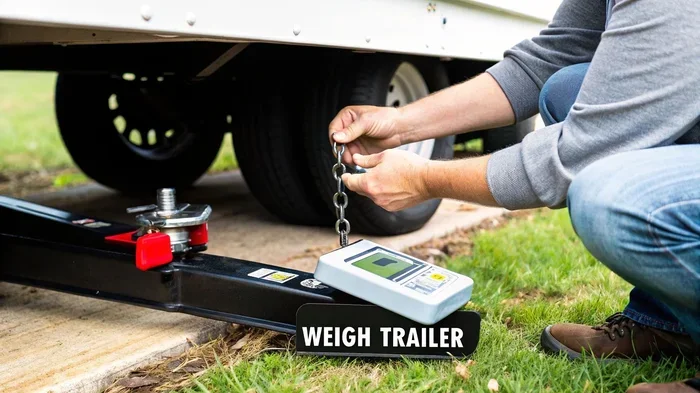
The most accurate way to measure tongue weight is with a dedicated tongue weight scale. These scales are affordable and easy to find at hardware stores or online. You simply place the scale under the hitch ball with the trailer attached, and it gives you a direct reading.
Here is how to do it step by step:
- Level your vehicle and trailer on flat ground.
- Attach the trailer to your vehicle as you normally would.
- Slide the tongue weight scale under the hitch ball.
- Read the measurement on the scale.
- Compare the number to 10-15% of your total trailer weight.
Method 2: Use a Standard Scale
If you do not have a tongue weight scale, you can use a standard bathroom scale. Set the scale on the ground and lower the hitch ball onto the scale at the same height it would be when towing. The reading gives you a close approximation of your tongue weight.
For a more precise measurement with a standard scale, you can use the leverage method. Place the hitch ball on the scale and support the trailer’s front at a reference point. Measure the distance from the scale to the reference point and from the reference point to the trailer axle. Use these distances to calculate the actual tongue weight using a simple ratio.
Quick Tips for Accurate Measurement
- Always measure with the trailer fully loaded as you plan to tow it.
- Measure on flat, level ground for the most accurate reading.
- Recheck tongue weight after loading or unloading any cargo.
- Do not guess — always measure. Guessing is the number one cause of tongue weight problems.
Common Towing Mistakes and How to Avoid Them
Mistake 1: Ignoring Tongue Weight Entirely
The most common mistake is simply not thinking about tongue weight at all. Many people focus only on whether their vehicle can pull the trailer and forget about how the trailer’s weight is distributed. This leads to trailer sway, poor braking, and uneven tire wear.
To avoid this, make tongue weight measurement a part of every towing setup. Before every trip, check that your tongue weight falls within the 10-15% range. It takes just a few minutes and can prevent hours of trouble on the road.
Mistake 2: Overloading the Rear of Your Vehicle
When tongue weight is too high, it pushes the rear of your vehicle down. This affects your headlight aim, reduces ride comfort, and strains your rear suspension components. Over time, this can cause premature wear on shocks, springs, and tires.
The fix is to redistribute cargo. Move heavier items forward in the trailer (closer to the axle) to reduce tongue weight. Or use a weight distribution hitch to help spread the load more evenly across all axles.
Mistake 3: Using the Wrong Hitch or Ball Size
Not all trailer hitches are created equal. Using the wrong hitch weight class or ball size can lead to unsafe towing conditions. Class I and II hitches are designed for lighter loads, while Class III, IV, and V hitches handle heavier trailers.
Always match your hitch to your towing needs. Check the hitch rating, the ball size, and the receiver capacity. A properly rated hitch ensures that both your towing capacity and your tongue weight are safely managed.
Mistake 4: Forgetting About Trailer Brakes
Heavy trailers need their own braking system. When tongue weight is high, the trailer’s brakes help slow down the entire rig. Without trailer brakes, all the stopping power falls on your vehicle’s brakes, which can lead to overheating and brake fade on long downhill grades.
Check your local towing regulations for brake requirements. Many states require trailer brakes for trailers over 3,000 pounds. Always make sure your trailer brakes are properly adjusted and functioning before every trip.
Expert Tips for Safe and Efficient Towing
Invest in a Weight Distribution Hitch
A weight distribution hitch is one of the best investments you can make for towing safety. It uses spring bars to redistribute tongue weight across all axles of your tow vehicle and trailer. This levels your vehicle, improves handling, and reduces the strain on your rear suspension.
Weight distribution hitches are especially helpful when you are towing near the upper limits of your vehicle’s capacity. They keep your vehicle level and your trailer stable, even when carrying heavy loads.
Check Your Tires Before Every Trip
Tire pressure affects both towing capacity and handling. Underinflated tires generate more heat and are more prone to blowouts. Overinflated tires reduce traction and provide a harsher ride.
Check your tire pressure when the tires are cold, before you drive anywhere. Follow the pressure recommendations in your owner’s manual or on the tire information label. Do not rely on the pressure listed on the tire sidewall — that is the maximum pressure, not the recommended pressure for towing.
Drive Defensively When Towing
Towing a trailer changes how your vehicle drives. You have more weight, a longer stopping distance, and a wider turning radius. Adjust your driving habits accordingly:
- Increase your following distance to allow for longer stopping times.
- Use lower gears on downhill grades to reduce brake wear.
- Make wider turns to avoid clipping curbs or other vehicles.
- Avoid sudden braking or sharp steering movements.
- Check your mirrors frequently to monitor trailer stability.
Perform Regular Maintenance on Your Towing Setup
Your towing equipment takes a beating on every trip. Inspect your trailer hitch, hitch ball, wiring connections, and safety chains before every journey. Look for wear, rust, or looseness. Replace any damaged components immediately.
Also, check your vehicle’s fluid levels, brakes, and suspension more frequently when you tow regularly. Towing puts extra stress on every system in your vehicle, and proactive maintenance prevents breakdowns and accidents.
Key Takeaways
- Towing capacity and tongue weight are not the same thing. Towing capacity is the maximum trailer weight your vehicle can pull. Tongue weight is the downward force on the hitch.
- Tongue weight should be 10-15% of your total trailer weight. This range keeps your trailer stable and your vehicle balanced.
- Tongue weight counts toward your vehicle’s payload capacity. It does not count toward your towing capacity. Always account for it separately.
- Use a tongue weight scale to measure accurately. Do not guess — an incorrect tongue weight can cause trailer sway or vehicle damage.
- Weight distribution hitches help manage tongue weight. They spread the load across all axles for safer, more stable towing.
- Always follow manufacturer guidelines for towing limits. Your owner’s manual and vehicle labels provide the most accurate information.
Conclusion
The question does towing capacity include tongue weight comes up a lot, and for good reason. Getting this wrong can lead to unsafe towing, vehicle damage, and even accidents on the road. The bottom line is simple: towing capacity and tongue weight are separate numbers that serve different purposes.
Your towing capacity tells you how heavy of a trailer you can pull. Your tongue weight tells you how much downward force the trailer puts on your hitch. And your payload capacity tells you how much total weight your vehicle can carry — including tongue weight, passengers, and cargo.
By understanding these distinctions and following the 10-15% tongue weight rule, you set yourself up for safe, smooth, and stress-free towing. Take the time to measure your tongue weight before every trip. Invest in the right equipment. And always respect the limits set by your vehicle’s manufacturer. Towing can be incredibly rewarding — as long as you do it right.
Now that you know the answer to does towing capacity include tongue weight, you are better equipped to hit the road with confidence. Share this knowledge with fellow towing enthusiasts, and always prioritize safety over speed or convenience. Happy towing.
Frequently Asked Questions
What happens if tongue weight is too high?
Excessive tongue weight pushes the rear of your vehicle down, reducing steering control and headlight alignment. It can also overload your rear suspension and tires, leading to premature wear or even a blowout. In extreme cases, too much tongue weight makes your vehicle dangerous to drive.
What happens if tongue weight is too low?
Too little tongue weight causes trailer sway, which is when the trailer swings side to side behind your vehicle. Trailer sway is extremely dangerous, especially at highway speeds or in crosswinds. It can lead to jackknifing or loss of control if not corrected quickly.
How do I measure tongue weight at home?
The easiest way is to use a tongue weight scale, which you place under the hitch ball with the trailer attached. If you do not have a scale, you can use a standard bathroom scale by lowering the hitch ball onto it at towing height. For the most accurate reading, always measure with the trailer fully loaded.
Does tongue weight count as payload?
Yes, tongue weight counts toward your vehicle’s payload capacity. It is part of the total weight your vehicle carries, including passengers, cargo, and the downward force from the trailer hitch. It does not count toward your towing capacity, which is the weight of the trailer behind you.
Can I tow at maximum capacity if my tongue weight is correct?
Not necessarily. Even if your tongue weight falls within the 10-15% range, you still need to stay within your vehicle’s towing capacity, payload capacity, and gross combined weight rating. All of these numbers work together to determine your safe towing limits. Check your owner’s manual for the full picture.
What is a weight distribution hitch and do I need one?
A weight distribution hitch uses spring bars to redistribute tongue weight across all axles of your tow vehicle and trailer. It helps level your vehicle and improves handling when towing heavy loads. You should consider one if you regularly tow near your vehicle’s maximum capacity or notice rear sag and poor handling while towing.