Why a Car Starting from Rest Accelerates at the Rate f
When a car starts from rest and accelerates at the rate f, it follows fundamental physics principles that govern how vehicles gain speed from a standstill. Understanding this acceleration rate helps drivers and enthusiasts grasp how engine power, weight, and force work together to deliver performance. This guide breaks down the science, real-world applications, and practical tips behind a car starting from rest accelerates at the rate f in simple, easy-to-follow terms.
Have you ever wondered what makes a car go from a complete stop to full speed so quickly? The answer lies in a simple but powerful concept: a car starting from rest accelerates at the rate f. This idea is at the heart of vehicle performance and physics. Whether you are a car enthusiast or just curious about how your daily driver works, understanding acceleration from rest changes the way you think about driving.
The rate f represents the constant acceleration a vehicle experiences when it begins moving from zero velocity. This concept connects Newton’s laws of motion with real-world car performance. Every time you press the gas pedal, your car undergoes this exact type of acceleration. Let us break down exactly what this means and why it matters for every driver.
In this article, we will explore the physics behind acceleration from a standstill, look at real-world examples, and share practical tips to help you understand and even improve your vehicle’s performance. By the end, you will have a clear picture of how a car starting from rest accelerates at the rate f and what factors influence this critical aspect of driving.
Key Takeaways
- Acceleration from rest is the foundation of vehicle performance: A car starting from rest accelerates at the rate f based on net force and mass, following Newton’s second law.
- Engine power and torque drive the acceleration rate: Horsepower and gear ratios directly influence how quickly a vehicle goes from zero to full speed.
- Multiple factors affect acceleration: Weight, friction, rolling resistance, and road conditions all play a role in how a car performs from a standstill.
- Kinematic equations predict acceleration behavior: Simple formulas help calculate distance, time, and final velocity for any vehicle accelerating from rest.
- Regular maintenance improves acceleration: Engine tuning, tire pressure, and weight reduction can boost your car’s rate of speed increase.
- Real-world examples make the concept tangible: Comparing sports cars and economy vehicles shows how different acceleration rates feel in everyday driving.
📑 Table of Contents
- What Does It Mean When a Car Starts from Rest?
- The Physics Behind Acceleration from Rest
- How Engine Power Relates to Acceleration Rate f
- Real-World Examples of Cars Accelerating from Rest
- Common Factors That Affect Acceleration Rate f
- Tips to Improve Your Car’s Acceleration from Rest
- Key Takeaways
- Conclusion
What Does It Mean When a Car Starts from Rest?
Understanding Initial Velocity and Acceleration
When we say a car starts from rest, we mean the vehicle has an initial velocity of zero. The car is completely stationary before the driver hits the accelerator. This starting point is crucial in physics because it simplifies the math and helps us focus on the acceleration phase alone.
Acceleration is the rate at which velocity changes over time. When a car begins from a standstill, every bit of speed it gains comes from the acceleration applied by the engine. The faster the acceleration, the quicker the car reaches higher speeds. This is why a car starting from rest accelerates at the rate f is such an important concept in automotive science.
Think of it this way. You are sitting at a red light. The moment the light turns green, you press the pedal. Your car goes from zero to moving forward. That transition from stillness to motion is acceleration from rest. The rate at which this happens depends on several factors we will explore below.
Why Starting from Rest Matters for Car Performance
Starting from rest is the most demanding phase of driving for a vehicle. The engine must overcome inertia, which is the tendency of a stationary object to stay still. This initial push requires maximum torque and force from the engine.
Here are key reasons why the rest-to-motion phase is so important:
- It determines launch quality: How smoothly and quickly a car leaves the line matters for both performance and comfort.
- It affects fuel efficiency: Hard acceleration from rest uses more fuel than gentle starts.
- It impacts safety: Quick acceleration from a standstill helps drivers merge onto highways or clear intersections safely.
- It reflects engine health: A car that struggles to accelerate from rest may have underlying mechanical issues.
Understanding this phase helps drivers appreciate what their engines are doing every single time they start moving.
The Physics Behind Acceleration from Rest
Newton’s Second Law and Force
The foundation of why a car starting from rest accelerates at the rate f comes from Newton’s second law of motion. This law states that force equals mass times acceleration, or F equals m times a. In our case, the acceleration is f, so the equation becomes F equals m times f.
This simple equation tells us a lot. The greater the force the engine produces, the higher the acceleration. But the heavier the car, the more force is needed to achieve the same rate f. This is why lightweight sports cars accelerate faster than heavy trucks, even with similar engine sizes.
The net force on a car accelerating from rest includes the engine’s driving force minus opposing forces like friction and air resistance. When the net force is positive, the car speeds up. When the forces balance out, acceleration stops and the car reaches a constant speed.
Kinematic Equations for Acceleration from Zero
Physics gives us handy equations to describe motion when a car starts from rest. These kinematic equations use the acceleration rate f to predict how a car behaves.
The three main equations are:
- Velocity equation: v equals f times t. This tells us the final velocity equals the acceleration rate multiplied by time.
- Distance equation: d equals one-half times f times t squared. This calculates how far the car travels during acceleration.
- Velocity-distance equation: v squared equals 2 times f times d. This links final speed to the distance covered.
These equations make it easy to calculate exactly how fast a car will be going after a certain time or how far it travels while accelerating. They are the backbone of car acceleration physics and help engineers design better vehicles every day.
Velocity-Time Graphs for Acceleration from Rest
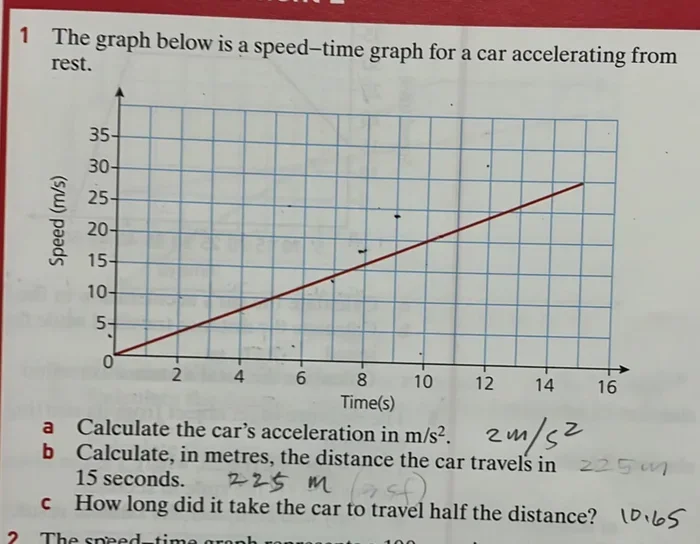
A velocity-time graph is one of the best ways to visualize how a car starting from rest accelerates at the rate f. On this graph, time sits on the horizontal axis and velocity on the vertical axis.
When acceleration is constant, the graph forms a straight line starting from the origin. The slope of this line equals the acceleration rate f. A steeper slope means faster acceleration. A flatter slope means the car gains speed more slowly.
This visual tool helps students and engineers alike understand how different vehicles compare. A sports car’s velocity-time graph shows a steep line, while a heavy SUV shows a gentler slope. Both start from rest, but their acceleration rates differ significantly.
How Engine Power Relates to Acceleration Rate f
Torque, Horsepower, and Gear Ratios
Engine power is what makes a car move. Two key measurements define this power: torque and horsepower. Torque is the twisting force the engine produces, and it is what gets a car moving from a standstill. Horsepower measures how quickly work gets done.
When a car starts from rest, torque is king. The engine’s torque goes through the transmission and drivetrain to the wheels. Gear ratios multiply this torque to give the wheels enough force to overcome inertia. A lower gear ratio in first gear means more torque at the wheels, which produces a higher acceleration rate f.
Here is how the pieces fit together:
- Engine torque: Creates the raw rotational force.
- Gear ratio: Multiplies torque at the wheels for the initial launch.
- Tire size: Affects how much of that force translates into forward motion.
- Drivetrain efficiency: Determines how much power is lost between the engine and the road.
All of these components work together to determine the acceleration rate f that a driver feels every time they step on the gas.
Why 0 to 60 Times Matter
The 0 to 60 miles per hour test is the gold standard for measuring a car’s acceleration from rest. This benchmark gives drivers a clear, comparable number for how fast a vehicle can go from a standstill to highway speed.
A car that hits 60 mph in 3 seconds has a much higher average acceleration rate f than one that takes 8 seconds. The difference comes down to engine power, weight, traction, and gearing. Every fraction of a second matters in the automotive world, and the 0 to 60 time tells the full story of a car’s launch capability.
For everyday drivers, the 0 to 60 time might seem like a number that only matters to speed enthusiasts. But it actually reflects the overall health and efficiency of the vehicle’s powertrain. A car that struggles to accelerate from rest may need a tune-up or new spark plugs.
Real-World Examples of Cars Accelerating from Rest
Sports Cars vs Economy Cars
The difference in acceleration between a sports car and an economy car is dramatic. A sports car like a Chevrolet Corvette can go from 0 to 60 in under 3 seconds because it produces massive torque and keeps weight low. The acceleration rate f is very high.
An economy car like a Honda Civic takes around 7 to 8 seconds for the same run. It still follows the same physics of a car starting from rest accelerates at the rate f, but the rate is much lower. The engine produces less torque, and the car is designed for fuel efficiency over raw speed.
Here is a quick comparison:
- Sports car: High torque, low weight, aggressive gear ratios, high acceleration rate f.
- Economy car: Moderate torque, lightweight design, fuel-focused gearing, lower acceleration rate f.
- Truck or SUV: High torque but heavy weight, lower acceleration rate f despite powerful engines.
Each vehicle type uses the same basic physics, but the results feel very different behind the wheel.
Electric Vehicles and Instant Acceleration
Electric vehicles like the Tesla Model 3 offer a unique advantage when it comes to acceleration from rest. Electric motors deliver maximum torque instantly, meaning there is no delay waiting for the engine to spool up. This gives EVs an incredibly high acceleration rate f from the moment the driver presses the pedal.
Many electric cars can hit 60 mph in under 4 seconds, and some performance models do it in under 2 seconds. The instant torque delivery makes the experience of a car starting from rest accelerates at the rate f feel almost effortless. There is no lag, no gear shifting, and no waiting for power to build.
This is one reason why electric vehicles are changing the automotive landscape. The physics of acceleration from rest favor electric powertrains in a big way.
Common Factors That Affect Acceleration Rate f
Vehicle Weight and Mass
The heavier a car is, the harder it is to accelerate. Newton’s second law makes this clear: more mass means less acceleration for the same force. A lighter car will always have a higher acceleration rate f than a heavier car with the same engine power.
This is why car manufacturers spend so much time trying to reduce vehicle weight. Every pound removed from the body, seats, or components improves the acceleration from rest. Even small weight savings add up over time and make a noticeable difference in how a car feels when you launch it.
Friction and Rolling Resistance
Friction works against acceleration. When a car starts from rest, the tires must grip the road surface to push the vehicle forward. If friction is too low, such as on ice or wet roads, the tires spin and the car does not accelerate properly.
Rolling resistance from tires also plays a role. Wider, softer tires create more grip but also more rolling resistance. This trade-off affects the net force available for acceleration and ultimately influences the rate f.
Here are the main friction-related factors:
- Tire tread condition: Worn tires reduce grip and slow acceleration.
- Road surface: Dry pavement offers better traction than wet or icy roads.
- Tire pressure: Underinflated tires increase rolling resistance and reduce acceleration.
- Drivetrain type: All-wheel drive systems distribute force better and improve launch traction.
Air Resistance at Higher Speeds
While air resistance is minimal at low speeds right after a car starts from rest, it grows quickly as velocity increases. At higher speeds, aerodynamic drag becomes a major opposing force that limits the acceleration rate f.
This is why sports cars invest heavily in aerodynamic design. Streamlined body shapes reduce drag and allow the car to maintain a higher acceleration rate for longer before reaching its top speed.
Tips to Improve Your Car’s Acceleration from Rest
Keep Your Engine Tuned and Maintained
A well-maintained engine produces more power and delivers it more efficiently. Regular oil changes, spark plug replacements, and air filter cleaning all contribute to better acceleration from rest. When your engine runs smoothly, the rate f improves naturally.
Here are simple maintenance steps that help:
- Change your engine oil every 5,000 to 7,500 miles.
- Replace spark plugs according to the manufacturer’s schedule.
- Keep your air filter clean and replace it when dirty.
- Check your fuel injectors for clogs or buildup.
These small steps add up to a noticeable difference in how quickly your car leaves the line.
Reduce Unnecessary Weight
Every extra pound in your car is weight the engine must overcome. Clear out your trunk and back seat of items you do not need. Remove roof racks when they are not in use. These simple changes reduce mass and help your car achieve a higher acceleration rate f.
While you cannot change the fundamental weight of your vehicle, removing unnecessary load is one of the easiest and cheapest ways to improve acceleration from rest.
Use Proper Tire Pressure
Keeping your tires at the recommended pressure ensures maximum grip and minimum rolling resistance. Check your tire pressure at least once a month, especially before long trips. Properly inflated tires give your car the best possible launch when accelerating from a standstill.
Master Your Driving Technique
How you drive affects acceleration more than you might think. Smooth, steady pressure on the gas pedal gives the engine time to build power efficiently. Launching too aggressively can cause wheel spin, which wastes energy and slows you down.
For manual transmission cars, launching in the right gear with the right RPM makes a big difference. For automatic cars, using sport mode or manual shift options can optimize the acceleration rate f by holding lower gears longer.
Key Takeaways
- The physics of acceleration from rest is straightforward: A car starting from rest accelerates at the rate f based on net force divided by mass, following Newton’s second law.
- Engine torque and gearing are the primary drivers: They determine how much force reaches the wheels and how effectively it converts into forward motion.
- Multiple real-world factors influence the rate f: Weight, friction, air resistance, and road conditions all play a role.
- Electric vehicles excel at acceleration from rest: Instant torque delivery gives them a natural advantage in the 0 to 60 test.
- Maintenance and driving habits matter: A tuned engine, proper tires, and smart driving technique all improve your car’s acceleration from a standstill.
Conclusion
The concept of a car starting from rest accelerates at the rate f is one of the most fundamental ideas in automotive physics. It connects basic Newtonian mechanics with the real-world experience of driving. Every time you press the gas pedal from a stoplight, your car is living this principle in action.
Understanding how acceleration from rest works gives you a deeper appreciation for what your vehicle does every day. Whether you drive a zippy sports car or a practical economy car, the same physics apply. The rate f depends on force, mass, and the many factors we explored in this guide.
Use the tips in this article to improve your car’s acceleration and get more out of every drive. Keep up with maintenance, watch your weight, and pay attention to your tires. Small changes lead to big improvements in how your car launches from a standstill.
The next time you feel that push in your seat as the light turns green, remember the science behind it. You are experiencing acceleration from rest, driven by force and shaped by the design of your vehicle. And now you know exactly what is happening under the hood.
Frequently Asked Questions
What does it mean when a car starts from rest and accelerates at the rate f?
It means the vehicle begins from a complete stop with zero initial velocity and gains speed at a constant rate f. This rate depends on the net force applied by the engine and the car’s mass, following Newton’s second law of motion.
Why is acceleration from rest different from acceleration at higher speeds?
At rest, the engine must overcome inertia and static friction to get the car moving. At higher speeds, air resistance and rolling resistance increase, which can reduce the effective acceleration rate f over time.
How does vehicle weight affect the acceleration rate f?
Heavier vehicles require more force to achieve the same acceleration rate f. Lighter cars accelerate faster from rest because the engine’s force has less mass to move, resulting in a higher rate of speed increase.
Do electric cars accelerate faster from rest than gas cars?
Many electric cars accelerate faster from rest because electric motors deliver maximum torque instantly. This gives them a higher acceleration rate f compared to gas engines, which need time to build up power through the drivetrain.
Can I improve my car’s acceleration from rest with simple changes?
Yes. Keeping your engine well-maintained, reducing unnecessary weight, using proper tire pressure, and improving your driving technique can all help your car achieve a better acceleration rate f from a standstill.
What role do gear ratios play in acceleration from rest?
Lower gear ratios in first and second gears multiply the engine’s torque at the wheels. This increased force produces a higher acceleration rate f, allowing the car to launch more quickly from a complete stop.
=== SEO TITLE ===
Why a Car Starting from Rest Accelerates at the Rate f
=== META TITLE ===
Car Starting from Rest Accelerates at Rate f Explained
=== URL SLUG ===
car-starting-rest-accelerates-rate-f