Where Is the Paint Code Normally Located on Your Car
Finding your car’s paint code is easier than you think. The paint code location varies by car maker, but it is almost always on a sticker or plate hidden in a common spot. Most vehicles hide it on the driver’s side door jamb, under the hood, or inside the glove box. This guide shows you exactly where to look on your specific car.
Have you ever needed to touch up a scratch on your car or get an exact color match for a repair? The first step is finding your paint code. This small alphanumeric code tells paint shops and auto parts stores exactly which color formula matches your vehicle. Without it, you risk buying the wrong shade and wasting time and money.
But here is the tricky part. There is no single universal spot where every car hides this code. Different car manufacturers place the paint code location in different areas. Some hide it in plain sight. Others tuck it away where you would never think to look. This guide will walk you through every common spot so you can find your code fast.
Whether you drive a Toyota, Ford, Honda, Chevrolet, BMW, or any other brand, you will find practical steps inside. We will cover the most common where is the paint code normally located on a car answers, share expert tips, and help you avoid the mistakes that trip up most car owners.
Key Takeaways
- Door jamb sticker: The most common place to find your paint code on nearly all car brands.
- Under the hood: Many manufacturers place the paint code sticker on the firewall or hood latch area.
- Spare tire well: Some cars hide the code underneath the trunk carpet or inside the spare tire compartment.
- Owner’s manual: Your manual often lists the paint code location for your specific model.
- Online databases: You can look up your paint code using the VIN number if you cannot find the sticker.
- Multiple locations: Some cars have the code in more than one spot, so check all common areas.
- Color match matters: Having the correct paint code ensures an accurate touch-up or repaint match.
📑 Table of Contents
- What Is a Car Paint Code and Why Does It Matter?
- Where Is the Paint Code Normally Located on a Car
- Paint Code Locations by Car Brand
- How to Find Your Paint Code When the Sticker Is Missing or Faded
- Common Mistakes People Make When Looking for Their Paint Code
- Using Your Paint Code for Touch-Ups and Repairs
- Can You Find Your Paint Code Online?
- Frequently Asked Questions
- Conclusion
What Is a Car Paint Code and Why Does It Matter?
A car paint code is a unique combination of letters and numbers assigned by the manufacturer. It identifies the exact paint formula used on your vehicle when it rolled off the assembly line. Every color variant — whether it is a standard shade or a special premium finish — has its own distinct code.
Why does this matter so much? Paint formulas change slightly from year to year. Even the same color name on two different model years can have a different base mixture. The code ensures you get the precise match, not just a close guess.
How Paint Codes Work
When a car is built at the factory, it gets painted in a controlled environment. The OEM color code is tied directly to that specific formula. The code typically looks like a short string of characters. For example, it might be something like WA3452 or L902. This code is printed on a sticker or engraved on a plate somewhere on the vehicle.
Auto body shops use this code to mix paint. Touch-up pens, spray cans, and professional blend-all paints all rely on this code for accuracy. If you have the right code, you get a near-perfect match.
Why Finding the Correct Code Is Essential
Using the wrong paint code can lead to visible color differences. Even a slight mismatch stands out under sunlight or after a few months of UV exposure. This is especially true for metallic and pearl finishes, which are more complex to match. Having the correct vehicle paint code saves you from costly rework and frustration.
Where Is the Paint Code Normally Located on a Car
The most common answer to where is the paint code normally located on a car depends on the manufacturer. However, there are a few standard spots that cover the vast majority of vehicles. Let us go through them one by one.
The Driver’s Side Door Jamb
This is the number one spot. On most cars, trucks, and SUVs, the paint code sticker is on the driver’s side door jamb. Open your driver’s door and look at the frame — the vertical part where the door latches. You will usually find a sticker or embossed plate with lots of information.
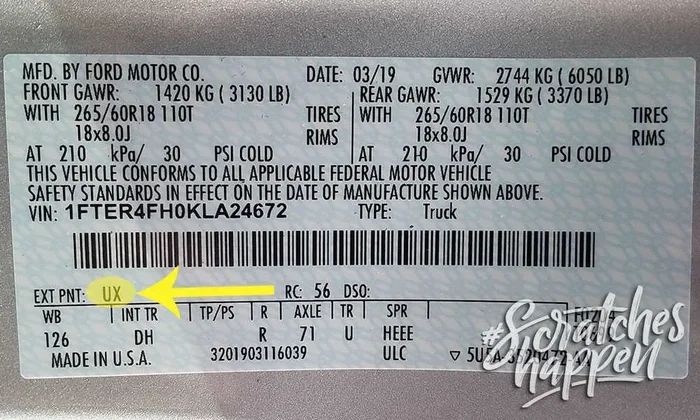
The sticker often includes the paint code alongside other details like tire pressure, curb weight, and the VIN number. The paint code is usually labeled as “Paint Code,” “Color Code,” or “Body Code.” It is typically a short combination of letters and numbers.
Quick Tip: If the sticker is worn out or hard to read, use your phone flashlight and zoom in with the camera. Sometimes the ink fades but the characters are still visible when you brighten the image.
Under the Hood
Many car makers place the paint code sticker under the hood. Common spots include the front firewall, the inner fender, the hood latch area, or the underside of the hood itself. Ford and Chrysler vehicles, for example, frequently hide the code in the engine bay.
Open the hood and look around the edges. The sticker may be on a plastic cover or directly on a metal surface. It might be partially hidden by a hose or wiring harness, so move things aside gently and look carefully.
Quick Tip: Check the owner’s manual for your specific model. It will often tell you the exact under-hood location for the paint code sticker.
The Glove Box Area
Some vehicles, especially certain Honda and Acura models, place the code inside the glove box or on a label inside the glove box door. Open the glove box and look at the underside of the lid or the side walls. The sticker may be partially covered by the box itself, so you might need to pull the glove box out slightly to see it.
The Spare Tire Compartment
This is a sneaky spot that catches many people off guard. Several car brands, particularly some European models, hide the paint code underneath the trunk carpet or inside the spare tire well. Lift the carpet and look for a sticker or a metal plate attached to the floor of the trunk.
In some vehicles, you may need to remove the spare tire entirely to access the code. The sticker could be on the inside of the spare tire housing or on a panel behind where the tire sits.
On the Vehicle Data Plate
Many cars have a dedicated vehicle data plate or build sticker. This plate contains a wealth of information about the vehicle, including the paint code, production date, and options list. The location varies widely. It could be on the B-pillar, the dashboard near the windshield, or the rear of the engine compartment.
BMW, Mercedes-Benz, and Audi vehicles often use a data plate system. The plate is usually bolted to the body and contains a wealth of factory information.
Paint Code Locations by Car Brand
Different brands have their own preferred spots for the paint code sticker. Here is a breakdown of where to look for some of the most popular car makers.
Ford Paint Code Location
Ford vehicles typically have the paint code under the hood. Look on the front firewall or the inner fender on the driver’s side. The sticker will usually say “Paint Code” or “Color Code” followed by the alphanumeric characters. Some Ford models also have the code on the driver’s door jamb.
Chevrolet Paint Code Location
Chevrolet often places the code on the driver’s side door jamb. Open the door and look for a sticker or plate. On some older models, you may also find it on the inside of the glove box or under the hood near the radiator support.
Toyota Paint Code Location
Toyota is consistent with the driver’s side door jamb location. The sticker is usually on the door frame itself. On some Toyota models, you can also find the code on a plate on the driver’s side dashboard, visible through the windshield.
Honda Paint Code Location
Honda vehicles often have the paint code on a sticker inside the driver’s door jamb. However, some Honda models also place the code in the engine bay on a sticker attached to the firewall. Check both locations to be thorough.
BMW Paint Code Location
BMW uses a vehicle data plate system. The plate is usually found on the driver’s side door jamb or on the inner fender. The paint code is listed as “Farbe” or “Color” followed by the code. Some BMW models also have the code on a sticker in the trunk.
How to Find Your Paint Code When the Sticker Is Missing or Faded
Sometimes the sticker is simply gone. Maybe a previous owner replaced the door handle and removed it. Or years of weather and road grime have made it unreadable. Do not worry. There are backup methods to find your paint code.
Use Your VIN Number
Your VIN number contains encoded information about your vehicle, including the factory paint color. Several online services allow you to enter your VIN and retrieve the paint code. Websites like the manufacturer’s own parts portal or third-party automotive databases can decode this information for you.
Simply enter your 17-character VIN into a reliable VIN decoder tool. The results will often include the factory paint color name and code. This method works for most makes and models built after 1980.
Check the Owner’s Manual
Your owner’s manual is a goldmine of vehicle information. Many manufacturers include a section that explains where the paint code sticker is located. If you still have the manual, check the index for “paint code” or “color code.”
Contact the Dealership
If all else fails, contact a dealership for your car brand. They can look up your vehicle using the VIN and provide the exact OEM color code. This is a free service at most dealerships. You may need to provide proof of ownership, so bring your registration or title.
Look at the Build Sheet
Some vehicles have a build sheet or order sheet that was included with the car at purchase. This document lists every option and specification, including the paint code. Check your paperwork, folders, or digital records if you kept them.
Common Mistakes People Make When Looking for Their Paint Code
Finding a paint code can be frustrating, and many people make avoidable mistakes. Here are the most common errors and how to skip them.
Assuming Every Car Has the Code in the Same Spot
This is the biggest mistake. Even within the same brand, different model years may use different locations. A 2010 Honda Civic might have the code on the door jamb, while a 2015 Civic puts it under the hood. Always verify the location for your specific model and year.
Confusing the Paint Code with the Interior Color Code
Some stickers list both exterior and interior color codes. Make sure you are reading the exterior body color code and not the interior upholstery code. The labels should make this clear, but it is easy to grab the wrong one in a hurry.
Relying on the Color Name Alone
Never try to match paint based on the color name alone. Two cars can both be called “Midnight Black” but have completely different paint formulas. Always use the alphanumeric code for an accurate color match.
Ignoring the Trim Level
Some car models have different paint codes depending on the trim level. A base model and an premium trim of the same car might use different formulations even if the color looks identical in the showroom. Make sure the code matches your exact trim and model year.
Using Your Paint Code for Touch-Ups and Repairs
Once you have your paint code, you can use it in several practical ways. The most common use is ordering touch-up paint for small chips and scratches. Auto parts stores and online retailers carry touch-up pens and small bottles matched to your specific code.
For larger repairs, professional body shops use the code to mix custom paint. They can blend the base coat, mid-coat, and clear coat to match your vehicle perfectly. This is especially important for metallic and tri-coat paint finishes, which have multiple layers that must align correctly.
Expert Insight: Always keep your paint code in a safe place. Take a photo of the sticker with your phone and save it in your phone’s photo app or cloud storage. This way, you will always have it handy even if the physical sticker deteriorates over time.
Quick Tips for Using Your Paint Code
- Clean the area before applying any touch-up paint to ensure proper adhesion.
- Test the color on a hidden spot first to confirm the match before applying to visible areas.
- Apply in thin layers rather than one thick coat for a smoother finish.
- Use a clear coat after the base color dries to protect the repair and add shine.
- Store leftover touch-up paint in a cool, dry place for future use.
Can You Find Your Paint Code Online?
Yes, in many cases you can. Several websites and apps allow you to look up your paint code using your vehicle’s make, model, year, and trim level. Some services are free, while others charge a small fee for detailed reports.
The most reliable method remains the physical sticker on the vehicle. Online lookups are helpful when the sticker is missing or illegible. However, always double-check any online code against your VIN to make sure it matches your specific vehicle configuration.
Frequently Asked Questions
Can I find my paint code on the VIN sticker?
Sometimes. The VIN sticker often contains the paint code alongside other factory information. However, not all VIN stickers include the paint code. Check the sticker carefully for a section labeled “Paint Code” or “Color Code.”
Is the paint code the same as the color name on the vehicle?
No. The color name is just a marketing label. The paint code is the specific alphanumeric identifier that tells paint mixers the exact formula to use. Always use the code, not the name, for any paint purchase or repair.
What if my car has been repainted and the original code is gone?
You can still find the code through your VIN using online decoders or by contacting the manufacturer’s dealership. The factory record retains the original paint code regardless of any subsequent repaints.
Do all cars have a paint code sticker?
Almost all cars manufactured after 1980 have a paint code sticker or plate. Very early vehicles or some specialty imports may not have one. In those cases, the dealership or manufacturer is your best resource.
Can I use the paint code from a similar model year to get a color match?
This is risky. Paint formulas can change between model years even on the same vehicle. Always use the exact code from your specific car to ensure the best possible match.
How long does it take to find the paint code on a car?
For most vehicles, finding the paint code takes just a few minutes. Start with the driver’s side door jamb, then check under the hood. If the sticker is missing, an online VIN lookup can retrieve it in seconds.
Conclusion
Knowing where is the paint code normally located on a car is one of the most useful pieces of knowledge any car owner can have. It saves you money, time, and frustration when you need a touch-up or a professional repair. The paint code location is almost always on the driver’s side door jamb, under the hood, or in the glove box, but it pays to check all common spots for your specific brand.
Keep your code safe by photographing the sticker and storing the image digitally. Use the code whenever you order touch-up paint or visit a body shop. And remember, the alphanumeric code is far more reliable than the color name alone.
With the information in this guide, you now have everything you need to locate your car paint code quickly and confidently. The next time a stone chip or scratch threatens your finish, you will be ready.