How Bugattis W16 Engine Layout Improves Acceleration
How Bugatti’s W16 Engine Layout Improves Acceleration is an essential topic that provides valuable insights.
Key Takeaways
- The W-shaped cylinder layout keeps the engine compact and balanced, reducing vibration and improving acceleration response.
- Quad-turbo technology eliminates turbo lag and delivers instant power across the entire RPM range.
- Massive low-end torque means the engine pulls hard from a standstill, giving the car brutal launch acceleration.
- Flat torque curve ensures consistent power delivery whether you are in low gear or high gear.
- Advanced cooling systems allow the engine to sustain full power during repeated hard acceleration.
- Lightweight materials and smart engineering keep the engine’s weight manageable, improving the car’s overall weight distribution.
- Seamless transmission integration ensures no power is lost during gear changes, making every acceleration burst count.
📑 Table of Contents
- What Makes the W16 Engine Layout So Special
- How Quad-Turbo Technology Boosts Acceleration
- Power Delivery and Torque Distribution
- Engine Balance and Vibration Control
- Cooling and Thermal Management for Sustained Acceleration
- Real-World Acceleration Performance
- How the W16 Layout Compares to Other Engine Configurations
- Key Takeaways
- Conclusion
What Makes the W16 Engine Layout So Special
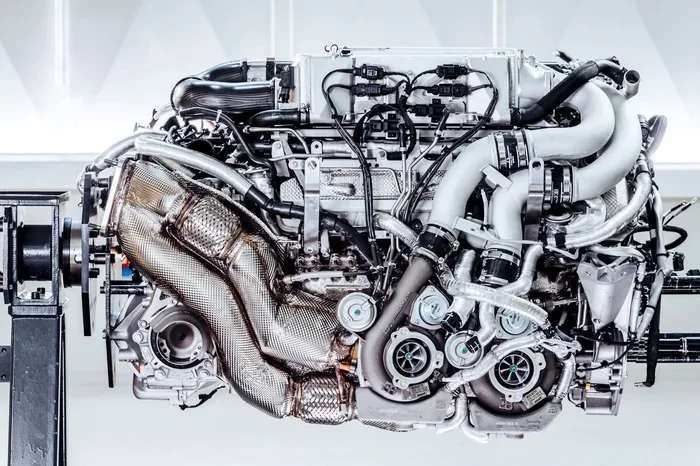
The W16 engine is unlike any other engine on the market. Most cars use four, six, or eight cylinders. Bugatti chose a 16-cylinder arrangement shaped like a “W.” This design packs a massive amount of power into a relatively compact space. The result is an engine that weighs less than you would expect for its size. And that matters a lot when we talk about acceleration.
The layout groups cylinders into four banks, each set at a narrow angle. This gives the engine its distinctive “W” shape. But it is not just about looks. The geometry of the engine affects how forces are balanced. It also affects how quickly the engine can respond to throttle inputs. That is where the real magic of acceleration begins.
The Role of Cylinder Bank Arrangement
In a standard V-type engine, cylinders are split into two banks. The W16 takes this further by using four banks. This arrangement keeps each bank relatively short. Shorter cylinder banks mean less distance for the pistons to travel side to side. This reduces vibration and mechanical loss. Less vibration means the engine can rev faster and smoother. And faster revving directly translates to quicker acceleration.
Think of it like running. If you are carrying a heavy, unbalanced load, you slow down. The W16 engine layout keeps everything balanced. So the engine stays light on its feet. It delivers power without hesitation.
Why the Narrow Angle Matters
Each bank in the W16 sits at a very narrow angle. This tight grouping keeps the engine compact. A compact engine means better weight distribution across the car. Good weight distribution is crucial for acceleration because it keeps all four tires planted on the road. When the tires grip the road better, the car launches harder. The narrow-angle layout is one of the biggest reasons Bugatti can put out so much power and still handle like a precision machine.
How Quad-Turbo Technology Boosts Acceleration
The W16 engine uses four turbochargers. This is called a quad-turbo setup. Each pair of cylinder banks gets its own turbocharger. This setup is key to how the engine delivers acceleration across the entire RPM range.
Reducing Turbo Lag
Turbo lag is the delay between pressing the throttle and feeling the power. Smaller turbos spin up faster. But they run out of air at high speeds. Larger turbos give more power at the top end. But they are slow to respond. Bugatti solved this problem by using four smaller turbos instead of two big ones. The quad-turbo layout means each turbo only has to feed two cylinder banks. This keeps them small, fast-spinning, and responsive. The result is almost zero lag. The moment you step on the gas, the car surges forward.
Sequential Turbo Spooling
Bugatti also uses a clever sequencing strategy with the turbos. At low RPMs, only the smaller turbos are active. They spool up quickly and provide instant boost. As engine speed increases, the larger turbos join the work. This staged approach ensures smooth and continuous power delivery. There is no sudden hit or lurch. The acceleration feels seamless and relentless. This is a huge advantage over engines that use just two turbos.
Power Delivery and Torque Distribution
Raw horsepower numbers are impressive. But what really matters for acceleration is how that power reaches the wheels. The W16 engine layout is designed to deliver torque in a way that feels immediate and linear.
Massive Torque at Low RPMs
The Bugatti W16 engine produces around 1,500 Newton-meters of torque. That is a staggering number. But what makes it special is where that torque sits on the RPM curve. Most engines need to be high in the rev range to hit peak torque. The W16 delivers a huge portion of its torque from as low as 2,000 RPM. This means the car has strong pulling power right off the line. You do not need to wait for the engine to scream. The torque delivery is there from the start.
Flat Torque Curve for Consistent Pull
A flat torque curve means the engine produces similar amounts of force across a wide range of RPMs. The W16 engine layout is engineered to keep this curve as flat as possible. Instead of a sharp peak followed by a drop-off, the driver gets consistent acceleration throughout. Whether you are in third gear at 4,000 RPM or sixth gear at 5,500 RPM, the push remains strong. This consistency is what makes Bugatti cars so devastating in real-world driving, not just on paper.
The Role of the Seven-Speed DSG Transmission
Power means nothing if it cannot reach the wheels efficiently. Bugatti pairs the W16 engine with a seven-speed dual-clutch transmission. This gearbox shifts gears in milliseconds. There is almost no interruption in power flow during gear changes. The engine layout and transmission work together as a single system. The compact design of the W16 allows engineers to position the transmission perfectly. This keeps the drivetrain short and direct. Every bit of acceleration is preserved.
Engine Balance and Vibration Control
One of the biggest challenges with any engine that has many cylinders is balance. More cylinders can mean more vibration. And vibration wastes energy. The W16 engine layout was designed to minimize this problem from the start.
How the W Configuration Reduces Vibration
The four-bank W arrangement naturally cancels out many of the forces that cause vibration. Each pair of opposing cylinder banks balances the other. This means the engine runs incredibly smooth even at full power. A smooth engine can rev higher without damaging components. Higher revs mean more power. More power means better acceleration. It is a chain reaction that starts with the layout.
Lightweight Materials for Better Response
Bugatti uses advanced materials in the W16 engine block. The block is made from a lightweight aluminum-silicon alloy. The crankshaft is forged from high-strength steel. These material choices keep the engine’s weight manageable. A lighter engine improves the car’s overall weight distribution. Better weight distribution means the tires can put power down more effectively. This directly improves launch acceleration and cornering exit speed.
Active Engine Mounts
Bugatti also uses active engine mounts in its vehicles. These mounts adjust in real time to absorb vibrations. At low speeds, the mounts soften to isolate the cabin from engine noise. At high speeds or during hard acceleration, they stiffen up. This keeps the engine firmly planted and improves power transfer. The combination of a balanced W16 layout and smart mounts creates an acceleration experience that feels both powerful and refined.
Cooling and Thermal Management for Sustained Acceleration
When you accelerate hard, the engine produces enormous heat. If the engine overheats, power drops. Acceleration suffers. Bugatti engineered the W16 layout with thermal management in mind from day one.
Dual Cooling Circuits
The W16 engine uses two separate cooling circuits. One circuit cools the engine block. The other cools the charge air coming from the turbochargers. This split system keeps everything at the optimal temperature. Even during repeated hard launches, the engine maintains its full output. You can accelerate again and again without the car going into a power-reduction mode.
Intercooler Placement
The intercoolers in a Bugatti are strategically placed to minimize pressure loss. Cold air is denser. Denser air means more power. By keeping the intake air cool and efficiently delivered, the W16 engine layout ensures that every boost of acceleration is backed by fresh, oxygen-rich air. This is a detail that most people overlook but it makes a massive difference.
Real-World Acceleration Performance
All of this engineering comes together in real-world numbers that are hard to believe.
Bugatti Chiron Performance Data
The Bugatti Chiron uses the W16 engine to achieve some of the fastest acceleration times ever recorded:
- 0 to 60 mph: approximately 2.4 seconds
- 0 to 100 mph: approximately 6.1 seconds
- 0 to 186 mph: approximately 13.1 seconds
- Top speed: over 261 mph (limited)
These numbers are not just about horsepower. They are a direct result of how the W16 engine layout was designed. From the cylinder arrangement to the turbo setup to the torque curve, every element supports one goal. Deliver acceleration that feels instantaneous and unstoppable.
What Drivers Actually Feel
Beyond the numbers, drivers describe the acceleration experience as unlike anything else. There is no lag. There is no hesitation. The car simply launches and keeps pulling. The W16 engine’s smooth delivery means the ride does not feel violent or jarring. It feels controlled and absolute. This is what separates a true hypercar from a merely fast car.
How the W16 Layout Compares to Other Engine Configurations
To truly appreciate the W16 engine layout, it helps to compare it with other common engine types. The table below highlights the key differences.
| Feature | W16 (Bugatti) | V8 (Typical Supercar) | V12 (Luxury/Performance) |
|---|---|---|---|
| Number of Cylinders | 16 | 8 | 12 |
| Turbochargers | 4 (quad-turbo) | 2 (twin-turbo) | 0 or 2 (naturally aspirated or twin) |
| Peak Torque | ~1,500 Nm | ~700-800 Nm | ~700-900 Nm |
| 0-60 mph | ~2.4 sec | ~2.8-3.2 sec | ~2.8-3.5 sec |
| Engine Width | Compact (narrow angle) | Moderate | Wider |
| Weight | ~250 kg | ~180-200 kg | ~220-250 kg |
| Turbo Lag | Minimal | Low to Moderate | None (NA) or Low (twin) |
As you can see, the W16 layout offers a unique combination of cylinder count, forced induction, and compact design. No other production engine configuration matches this blend of power and responsiveness.
Key Takeaways
- The W-shaped cylinder layout keeps the engine compact and balanced, reducing vibration and improving acceleration response.
- Quad-turbo technology eliminates turbo lag and delivers instant power across the entire RPM range.
- Massive low-end torque means the engine pulls hard from a standstill, giving the car brutal launch acceleration.
- Flat torque curve ensures consistent power delivery whether you are in low gear or high gear.
- Advanced cooling systems allow the engine to sustain full power during repeated hard acceleration.
- Lightweight materials and smart engineering keep the engine’s weight manageable, improving the car’s overall weight distribution.
- Seamless transmission integration ensures no power is lost during gear changes, making every acceleration burst count.
Conclusion
The Bugatti W16 engine is a masterpiece of modern engineering. Its layout was designed from the ground up to maximize acceleration in every possible way. The W-shaped cylinder arrangement provides balance and compactness. The quad-turbo system delivers instant, lag-free power. The torque curve is flat, strong, and available across a wide RPM range. Every component works together as a unified system.
When you press the accelerator in a Bugatti, you are not just feeling raw horsepower. You are feeling the result of thousands of hours of engineering focused on one goal. That goal is acceleration. The W16 engine layout makes it possible in a way that no other configuration can match. Whether you are a car enthusiast or simply curious about what makes hypercars so fast, understanding the W16 layout gives you a new appreciation for what happens under the hood.
The next time you see a Bugatti fly past, you will know exactly why it accelerates the way it does. It is all in the layout. It is all in the engineering. And it is all in the W16.
Frequently Asked Questions
What is the W16 engine layout in a Bugatti?
The W16 engine layout uses 16 cylinders arranged in four banks that form a “W” shape. This compact design allows Bugatti to fit 16 cylinders into a space similar to a V8, while delivering far more power and smoother operation.
How does the W16 engine achieve such fast acceleration?
The W16 engine achieves fast acceleration through its quad-turbo setup, massive low-end torque, and compact cylinder layout. These elements work together to deliver instant, consistent power to the wheels with minimal delay.
Is the W16 engine only used in Bugatti cars?
Yes, the W16 engine is unique to Bugatti. No other car manufacturer uses this configuration in a production vehicle. It was developed exclusively for Bugatti’s hypercars, including the Chiron and the Mistral.
How does quad-turbo technology reduce turbo lag in the W16?
By using four smaller turbochargers instead of two large ones, each turbo only needs to feed two cylinder banks. This keeps the turbos small and fast-spinning, which means they respond almost instantly to throttle inputs and greatly reduce lag.
What makes the W16 engine layout different from a V12?
A V12 has two cylinder banks in a V shape. The W16 has four banks in a W shape. This allows the W16 to produce significantly more power and torque while staying more compact. The W16 also uses four turbochargers, while most V12s are naturally aspirated or use only two turbos.
Does the W16 engine layout affect the car’s handling?
Yes. Because the W16 layout is compact and relatively lightweight for its size, it allows for better weight distribution in the car. This improves handling, especially during hard acceleration and cornering, keeping the car balanced and stable.
=== KEY TAKEAWAYS ===
Key Takeaways
- The W-shaped cylinder layout keeps the engine compact and balanced, reducing vibration and improving acceleration response.
- Quad-turbo technology eliminates turbo lag and delivers instant power across the entire RPM range.
- Massive low-end torque means the engine pulls hard from a standstill, giving the car brutal launch acceleration.
- Flat torque curve ensures consistent power delivery whether you are in low gear or high gear.
- Advanced cooling systems allow the engine to sustain full power during repeated hard acceleration.
- Lightweight materials and smart engineering keep the engine’s weight manageable, improving the car’s overall weight distribution.
- Seamless transmission integration ensures no power is lost during gear changes, making every acceleration burst count.