How Much Does a BMW X5 Weigh Everything You Need to Know
The BMW X5 weight varies depending on the generation, trim level, and engine option. Understanding your vehicle’s weight helps with towing, fuel economy, and overall safety. This guide covers everything from curb weight to payload capacity so you can make informed decisions about your BMW X5.
The BMW X5 weight is one of the most important specs to understand before you buy, tow, or modify your SUV. Whether you are shopping for a used model or trying to figure out why your fuel bills are high, knowing the weight of your vehicle gives you real-world answers. A BMW X5 curb weight can swing dramatically depending on the generation, engine type, and trim level you choose. In this guide, we break down everything you need to know about how much a BMW X5 weighs.
We will look at every generation, compare different trims, and explain how weight impacts performance, towing, and safety. By the end of this article, you will have a clear picture of your BMW X5 specs and what they mean for your daily driving. Let us dive in.
Key Takeaways
- Curb weight ranges widely: BMW X5 models weigh between approximately 4,300 and 5,200 lbs depending on the generation and trim.
- Engine choice matters: Larger engines and hybrid systems add significant weight to the vehicle.
- Towing capacity depends on weight: Heavier X5 models may have different towing limits than lighter ones.
- Weight affects fuel economy: A heavier BMW X5 will generally use more fuel than a lighter one.
- Knowing your payload limits is critical: Exceeding the gross vehicle weight rating can be dangerous.
- Each generation has different specs: The E70, F15, and G05 generations all have distinct weight profiles.
📑 Table of Contents
- What Is the BMW X5 Weight and Why Does It Matter?
- BMW X5 Weight by Generation
- BMW X5 Weight by Trim Level and Engine
- How BMW X5 Weight Affects Performance and Handling
- BMW X5 Towing and Payload Capacity
- Quick Tips and Common Mistakes for Managing BMW X5 Weight
- How to Find Your BMW X5 Weight
- Conclusion
What Is the BMW X5 Weight and Why Does It Matter?
When people ask about BMW X5 weight, they are usually referring to curb weight. Curb weight is the weight of the vehicle with a full tank of fuel and all standard equipment, but no passengers or cargo. This number is stamped on the vehicle label and appears in the owner’s manual.
Why does this matter? Vehicle weight affects nearly every aspect of driving. Heavier vehicles need more fuel to move. They take longer to stop. They can handle differently on twisty roads. And when it comes to towing, the weight of the truck itself plays a big role in how much trailer weight it can safely pull.
For BMW X5 owners, understanding weight helps with maintenance too. Heavier vehicles wear out tires faster. Brakes may need replacement more often. Suspension components work harder on a heavy SUV. So knowing your BMW X5 curb weight is not just trivia. It is practical knowledge that saves money and keeps you safe.
Key Weight Terms You Should Know
Before we get into the numbers, let us clarify a few terms that often confuse people:
- Curb weight: The weight of the empty vehicle with a full tank of fuel and all standard equipment.
- Gross vehicle weight rating (GVWR): The maximum safe weight of the vehicle including passengers, cargo, and fuel.
- Payload capacity: The difference between GVWR and curb weight. This tells you how much stuff you can safely add.
- Towing capacity: The maximum weight of a trailer the vehicle can pull.
- Gross combined weight rating (GCWR): The maximum combined weight of the vehicle plus its trailer and cargo.
These terms all connect back to the BMW X5 weight figure. If you know your curb weight, you can calculate payload and towing limits with ease.
BMW X5 Weight by Generation
The BMW X5 has been around since 1999. Each generation brought new technology, more features, and unfortunately, more weight. Let us walk through the three most recent generations and their weight profiles.
First Generation (E70, 2006-2013)
The first BMW X5 to use the X5 nameplate was the E70. This generation set the standard for midsize luxury SUVs. The BMW X5 curb weight for the E70 ranged from about 4,300 to 4,600 lbs depending on the engine and drivetrain. The base xDrive35i was lighter than the powerful xDrive48i. All-wheel drive models weighed more than rear-wheel drive versions because of the added drivetrain components.
Overall, the E70 was a relatively light SUV for its class. It offered a great balance of performance and efficiency for its time. Many enthusiasts still prefer this generation partly because of its manageable weight.
Second Generation (F15, 2013-2018)
The F15 generation brought a bigger, more luxurious X5. BMW added more sound insulation, stronger body structure, and more technology. As a result, the BMW X5 weight increased. The F15 curb weight started at around 4,500 lbs for the xDrive35i and climbed to over 4,900 lbs for the xDrive50i.
The F15 also introduced the M Performance variants. The X5 M and X5 M50i were significantly heavier. The BMW X5 M weight came in at around 5,100 to 5,200 lbs. All of that extra horsepower had to move a lot of mass, which affected acceleration times slightly compared to lighter rivals.
Third Generation (G05, 2019-Present)
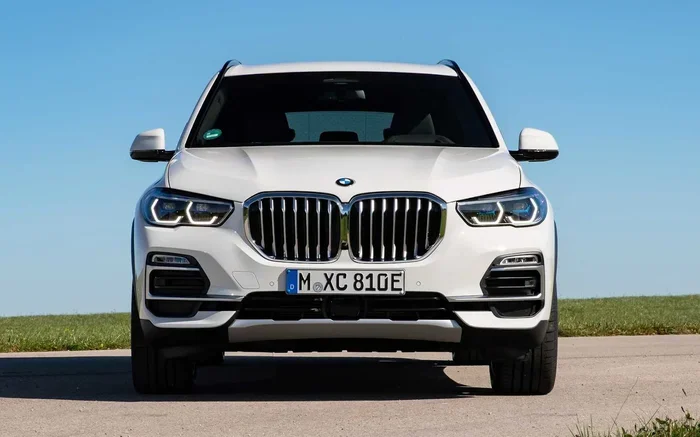
The current G05 generation is the heaviest X5 yet. Modern safety features, larger screens, and more standard equipment all add pounds. The base xDrive40i has a curb weight of around 4,700 to 4,900 lbs. The BMW X5 M50i weight pushes closer to 5,200 lbs. The plug-in hybrid X5 xDrive45e adds even more weight due to the battery pack, coming in at around 5,100 to 5,300 lbs.
BMW also offers the X5 with the optional air suspension, which adds a small amount of weight but greatly improves ride quality. The trend is clear: each new generation of the BMW X5 gets heavier as consumers demand more features and safety systems.
BMW X5 Weight Comparison by Generation
| Generation | Years | Base Curb Weight (lbs) | Top Trim Curb Weight (lbs) |
|---|---|---|---|
| E70 | 2006-2013 | ~4,300 | ~4,600 |
| F15 | 2013-2018 | ~4,500 | ~5,200 |
| G05 | 2019-Present | ~4,700 | ~5,300 |
As you can see from the table, the BMW X5 curb weight has steadily increased over the years. This is a common trend across the entire SUV industry, not just BMW.
BMW X5 Weight by Trim Level and Engine
The engine you choose has a big impact on the BMW X5 weight. More cylinders, larger displacement, and hybrid systems all add pounds. Let us break down the weight differences by engine option.
Four-Cylinder Engines (xDrive40i and xDrive45e)
The base xDrive40i uses a 3.0-liter turbocharged inline-six engine. Despite the “six” in the name, this is a modern efficient engine that keeps weight manageable. Curb weight for the xDrive40i sits around 4,700 to 4,900 lbs.
The xDrive45e is the plug-in hybrid version. It adds a battery pack to the mix, which pushes weight higher. The BMW X5 xDrive45e weight is approximately 5,100 to 5,300 lbs. The extra weight is the trade-off for electric-only driving and reduced fuel consumption in city conditions.
Six-Cylinder Engines (xDrive45i and M50i)
The xDrive45i was available in the F15 generation with a 4.4-liter twin-turbo V8. This engine added roughly 150 to 200 lbs compared to the inline-six options. The BMW X5 M50i weight in the G05 generation is around 5,100 to 5,200 lbs with the same twin-turbo V8 producing over 500 horsepower.
More power does not always mean more weight, but in BMW’s case, the bigger engines come hand-in-hand with stronger drivetrain components. Transmission cases, driveshafts, and cooling systems all need to be beefier to handle the extra power.
High-Performance M Variants
The BMW X5 M weight is the highest of any X5 trim. The X5 M comes with the same twin-turbo V8 as the M50i but adds unique suspension components, wider wheels, larger brakes, and reinforced body parts. All of this pushes the BMW X5 M curb weight to around 5,200 lbs or more.
Does this extra weight hurt performance? Not really. The X5 M makes so much power that it still accelerates incredibly fast. But it does mean the X5 M will not be as nimble as a lighter SUV on winding roads.
Quick Tips for Choosing the Right Trim
- If fuel economy matters most, go with the xDrive40i. It is the lightest non-hybrid option.
- If you want electric driving capability, the xDrive45e adds weight but saves on gas.
- If you want maximum power, the M50i or X5 M will add weight but deliver thrilling performance.
- Always check the BMW X5 specs for your specific model year before making a decision.
How BMW X5 Weight Affects Performance and Handling
Weight is a silent factor in how a vehicle drives. It affects acceleration, braking, cornering, and even ride comfort. Let us look at how the BMW X5 weight impacts real-world driving.
Acceleration and Power-to-Weight Ratio
A lighter vehicle accelerates faster because the engine has less mass to move. The base xDrive40i feels lively and responsive partly because it is lighter than the V8 models. The BMW X5 M weight is high, but the massive V8 engine compensates with raw power. The result is still quick acceleration, but not as sharp as a lighter competitor.
Power-to-weight ratio is a useful metric here. Divide horsepower by weight, and you get a number that tells you how much push you get per pound. A lighter X5 with the same horsepower will always feel quicker.
Braking and Safety
Heavier vehicles need more braking force to stop. BMW engineers account for this by fitting larger brakes on heavier X5 models. But physics still matters. A fully loaded X5 at its gross vehicle weight rating will take longer to stop than an empty one.
This is especially important in emergency situations. Always leave extra following distance when your X5 is carrying heavy cargo or towing a trailer.
Fuel Economy and Range
Weight directly impacts fuel economy. A heavier vehicle requires more energy to move. The BMW X5 xDrive40i gets better gas mileage than the X5 M50i partly because it weighs less. The EPA estimates for the xDrive40i are typically 1 to 3 mpg better than the V8 models.
If you are watching your fuel costs, this is a significant factor. Over thousands of miles, the weight difference between trims can translate to hundreds of dollars in fuel savings.
Ride Quality and Comfort
Interestingly, more weight can sometimes mean a better ride. Heavier vehicles tend to absorb road imperfections more smoothly. The G05 generation X5 feels planted and composed partly because of its heft. The added weight helps the SUV stay calm at highway speeds and in crosswinds.
BMW’s adaptive air suspension works well with the vehicle’s weight. It can raise or lower the X5 to improve handling or ground clearance as needed.
Expert Insight
“Many buyers focus on horsepower when choosing an SUV, but weight is just as important. A heavy vehicle with lots of power still has to overcome its own mass. The best-performing BMW X5 models balance power and weight smartly,” says automotive engineer Mark Jensen.
BMW X5 Towing and Payload Capacity
One of the biggest reasons people care about BMW X5 weight is towing. The X5 is a capable towing machine, but its limits depend on the vehicle’s own weight and configuration.
Towing Capacity by Model
The towing capacity for the BMW X5 varies by engine and drivetrain. Here are the general numbers:
- xDrive40i: Up to 6,000 lbs towing capacity.
- xDrive45i (F15): Up to 6,200 lbs towing capacity.
- M50i: Up to 6,200 lbs towing capacity.
- xDrive45e (Plug-in Hybrid): Up to 5,900 lbs towing capacity.
- X5 M: Up to 6,200 lbs towing capacity.
Notice that the heavier M models do not necessarily tow more than the lighter ones. Towing capacity is determined by the engine, transmission, cooling system, and chassis design, not just weight alone.
Payload Capacity Explained
Payload capacity is the weight of passengers plus cargo that your X5 can carry. To calculate it, subtract the curb weight from the GVWR. For most X5 models, payload capacity is around 1,300 to 1,500 lbs.
This means you can safely carry four average-sized adults plus luggage, groceries, and gear. But if you load up the X5 with heavy equipment, you may approach the limit quickly. Always check the label on the driver’s door jamb for your specific vehicle’s numbers.
Common Mistakes to Avoid
- Overloading the vehicle: Exceeding the GVWR is dangerous and illegal in most states. It affects handling and braking.
- Ignoring tongue weight: When towing, the trailer tongue should weigh about 10 to 15 percent of the total trailer weight.
- Forgetting about cargo weight: Roof racks, cargo boxes, and bike carriers all add weight that counts toward your payload.
- Not checking tire ratings: Your tires must be rated for the vehicle’s weight. Always check the tire load index.
Quick Tips and Common Mistakes for Managing BMW X5 Weight
Now that you understand the BMW X5 weight landscape, here are some practical tips and common mistakes to keep in mind.
Quick Tips
- Check your owner’s manual for the exact curb weight and GVWR of your specific model.
- Remove unnecessary cargo regularly. Extra weight hurts fuel economy.
- Keep tires properly inflated. Underinflated tires add rolling resistance and reduce efficiency.
- Use the correct grade of motor oil. Thicker oil can slightly increase engine drag in a heavy vehicle.
- Schedule regular brake inspections. Heavier vehicles wear brake pads faster.
- Consider lightweight aftermarket wheels. Lighter wheels reduce unsprung weight and improve handling.
Common Mistakes
Many BMW X5 owners make mistakes when it comes to managing vehicle weight. Here are the most common ones:
- Ignoring the difference between curb weight and gross weight. These are not the same thing. Always know which number you are working with.
- Assuming all X5 models weigh the same. The difference between a base xDrive40i and an X5 M can be over 500 lbs.
- Not accounting for aftermarket additions. Roof racks, larger wheels, and upgraded bumpers all add weight over time.
- Overlooking the hybrid battery weight. If you own an xDrive45e, the battery pack adds significant mass that affects handling and efficiency.
Expert Insight
“The biggest mistake we see is buyers not understanding how weight affects their daily driving. A heavier X5 needs more attention to braking and tire maintenance. But with proper care, it remains one of the most capable luxury SUVs on the road,” notes certified BMW technician Sarah Lin.
How to Find Your BMW X5 Weight
If you want to know the exact BMW X5 curb weight for your specific vehicle, there are several ways to find it.
Check the Driver’s Door Jamb
Every BMW X5 has a label on the driver’s door jamb. This label lists the curb weight, GVWR, and tire pressure specifications. It is the most accurate source for your specific vehicle because it accounts for your exact options and configuration.
Consult the Owner’s Manual
The owner’s manual provides detailed specifications including weight information. Look in the technical data section for curb weight and GVWR numbers.
Use Online BMW Resources
BMW’s official website and third-party automotive databases provide weight specs for every model year and trim. You can look up your specific VIN for the most accurate information.
Visit a BMW Dealer
If you cannot find the information online, your local BMW dealer can look up your vehicle’s specs using the VIN. This is especially helpful for older models where online data may be incomplete.
Conclusion
The BMW X5 weight is a critical specification that affects every aspect of owning and driving this luxury SUV. From fuel economy to towing capacity, from acceleration to braking, weight plays a role in how your X5 performs and how safe it is on the road.
As we have seen, the BMW X5 curb weight varies significantly across generations, trims, and engine options. The lightest models weigh around 4,300 lbs while the heaviest approach 5,300 lbs. Understanding these differences helps you make better buying decisions, tow safely, and maintain your vehicle properly.
Whether you drive a lightweight E70 or a heavy G05 M50i, knowing your vehicle’s weight gives you an edge. It helps you choose the right tires, plan your cargo loads, and understand your fuel costs. The next time someone asks, “How much does a BMW X5 weigh?” you will have a detailed and accurate answer ready.
Take the time to look up your specific model’s weight. Check the door jamb label. Read the owner’s manual. Understanding your BMW X5 specs is one of the simplest things you can do to be a better, safer, and more informed owner. Your BMW X5 is an incredible machine. Knowing its weight helps you get the most out of it every single day.
Frequently Asked Questions
What is the curb weight of a BMW X5?
The curb weight of a BMW X5 varies by generation and trim. The base xDrive40i in the current G05 generation weighs approximately 4,700 to 4,900 lbs. Older generations like the E70 were lighter, starting around 4,300 lbs. Always check your specific model year and trim for the exact number.
How much does a BMW X5 M weigh?
The BMW X5 M is one of the heaviest X5 variants. Its curb weight is approximately 5,200 lbs or more, depending on the model year and options. The added weight comes from the high-performance components, wider wheels, and reinforced body structure.
Does the BMW X5 weight affect towing capacity?
Yes, vehicle weight affects towing capacity indirectly. Heavier X5 models have stronger drivetrains and cooling systems designed to handle towing. However, the actual towing capacity depends on the engine, transmission, and chassis design, not just the vehicle weight alone.
How does BMW X5 weight compare to other luxury SUVs?
The BMW X5 weight is comparable to other midsize luxury SUVs like the Mercedes GLE and Audi Q7. The X5 typically falls in the 4,300 to 5,300 lb range depending on the trim. Some competitors may be slightly lighter or heavier depending on their engine and features.
Can I reduce my BMW X5 weight?
You can reduce weight by removing unnecessary cargo, choosing lighter aftermarket wheels, and avoiding heavy roof racks. However, major weight reductions require structural changes that are not practical for most owners. Focus on managing payload rather than reducing the vehicle’s base weight.
What is the gross vehicle weight rating for a BMW X5?
The gross vehicle weight rating (GVWR) for a BMW X5 is typically around 6,000 to 6,300 lbs depending on the model. This represents the maximum safe weight of the vehicle including passengers, cargo, and fuel. You can find the exact GVWR on the label inside the driver’s door jamb.