How Reliable Is a Honda Civic Compared to Other Cars
The Honda Civic is one of the most dependable compact cars on the market, consistently earning top marks in Honda Civic reliability ratings and car dependability studies. With a strong Honda Civic engine reliability record, low Honda Civic maintenance cost, and impressive Honda Civic lifespan, it stands out as a long-lasting car that holds its value exceptionally well. Whether you are considering a new or used Honda Civic, this guide covers everything you need to know about Honda Civic durability, common problems, and how it compares to other reliable cars on the road.
When you think about buying a reliable car, the Honda Civic almost always comes up in the conversation. It is one of the best-selling compact cars in America, and for good reason. People trust this vehicle to get them to work, run errands, and handle road trips without constant trips to the shop. But how reliable is a Honda Civic really? In this article, we break down Honda Civic reliability ratings, look at common Honda Civic problems, and compare the Civic to other popular cars so you can make a smart buying decision.
The Honda Civic has been around since 1972, and over those decades, it has built a reputation for being a dependable, affordable, and fun-to-drive compact car. Whether you are looking at a used Honda Civic or planning to buy the latest model, understanding how reliable this car truly is can save you time, money, and headaches. We will cover Honda Civic engine reliability, Honda Civic maintenance cost, Honda Civic lifespan, and much more. By the end, you will have a clear picture of whether the Civic is the right choice for you.
Honda Civic reliability is not just a marketing slogan. Independent studies, consumer surveys, and automotive publications consistently place the Civic near the top of their rankings. Let us dive deep into what makes this car so dependable and what you should know before buying one.
Key Takeaways
- Honda Civic reliability is outstanding: The Civic consistently ranks near the top of vehicle reliability indices and consumer surveys year after year.
- Honda Civic common issues are minor: Most problems are small and easy to fix, keeping your Honda Civic maintenance cost low over time.
- Honda Civic lifespan is impressive: With proper care, a Civic can easily surpass 200,000 miles, making it one of the longest-lasting cars available.
- Honda Civic resale value is strong: Civics hold their value remarkably well, giving you a solid return when it is time to sell or trade in.
- Honda Civic durability shines across generations: From older models to the latest Honda Civic generations, reliability remains a core strength.
- Honda Civic vs Toyota and Honda Civic vs Corolla comparisons favor the Civic: It often matches or beats rivals in reliability and ownership cost.
- Fuel efficiency Honda Civic models save money: Excellent gas mileage reduces your overall car ownership cost significantly.
📑 Table of Contents
What Makes the Honda Civic So Reliable?
Engineering and Build Quality
Honda has spent decades refining the Civic’s engineering. The engineers focus on simplicity and durability. Fewer complex parts mean fewer things that can go wrong. The Honda Civic engine reliability is a big part of this story. Honda engines are known for being overbuilt, meaning they are stronger than they need to be for normal driving. This extra strength translates into a longer Honda Civic lifespan and fewer major repairs.
The Civic also uses high-quality materials in its construction. The suspension components, braking system, and transmission are all designed with longevity in mind. Honda does not cut corners here, and it shows in the long-term dependability of the vehicle.
Proven Track Record Across Generations
One reason Honda Civic reliability remains so high is the consistency across Honda Civic generations. Whether you are looking at a 2005 model or a 2024 model, the core engineering philosophy stays the same. Honda refines its designs over time rather than reinventing them completely. This approach means that lessons learned from older models carry forward, making each new generation more reliable than the last.
The reliability survey data from major automotive organizations backs this up. Year after year, the Civic appears near the top of vehicle reliability indices. Honda consistently earns high marks from Consumer Reports reliability studies, and the Civic is always a standout performer in those rankings.
Fuel Efficiency Honda Civic Models Deliver
Another factor that adds to the overall Honda Civic reliability picture is fuel efficiency. The Civic is known for getting excellent gas mileage, which means less strain on the engine over time. When a car burns fuel efficiently, it runs cleaner and experiences less wear on internal components. This contributes directly to Honda Civic durability and reduces the likelihood of engine-related problems.
For buyers comparing fuel efficiency Honda Civic models with other compact cars, the Civic often comes out ahead. The combination of a lightweight body, efficient engine options, and smart engineering gives the Civic an edge in both city and highway driving. This efficiency also lowers your overall car ownership cost, since you spend less at the pump.
Quick Tips for Maximizing Honda Civic Reliability
- Change your oil every 5,000 to 7,500 miles using the recommended grade.
- Keep up with scheduled maintenance services at the recommended intervals.
- Check your tire pressure monthly to reduce unnecessary engine strain.
- Address small noises or warning lights immediately before they become big problems.
- Use genuine Honda parts for repairs and replacements to maintain quality standards.
Honda Civic Reliability Ratings and Reviews
What the Experts Say
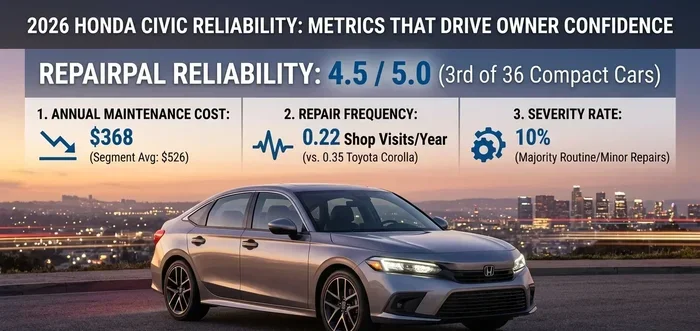
When it comes to car reliability ratings, the Honda Civic consistently earns top scores. J.D. Power, Consumer Reports, and RepairPal all give the Civic high marks for dependability. These ratings are based on real-world data from thousands of vehicle owners, so they reflect actual ownership experiences rather than theoretical projections.
J.D. Power awards the Civic high reliability scores in its annual Vehicle Dependability Study. Consumer Reports frequently rates the Civic as one of the most reliable compact cars available. RepairPal gives the Civic a reliability score above average for its class, which is impressive given how popular the model is.
Honda Civic Common Issues
No car is perfect, and the Honda Civic is no exception. While Honda Civic reliability is excellent overall, there are a few Honda Civic common issues that owners should be aware of. Understanding these potential problems helps you stay ahead of them and keep your car running smoothly.
Some of the most commonly reported Honda Civic problems include:
- Infotainment system glitches: Older models sometimes experience software freezes or Bluetooth connectivity issues. These are annoying but rarely affect the drivetrain.
- Engine oil consumption: Some Honda Civic generations, particularly certain 2016-2021 models, have been reported to use slightly more oil than expected. Regular oil level checks help catch this early.
- Transmission smoothness: Older Civics with automatic transmissions may experience occasional hesitation or rough shifting at low mileage. This is typically a minor issue.
- Rust on older models: Civics from the 1990s and early 2000s can develop surface rust on wheel wells and rocker panels if not properly maintained.
- Exhaust manifold cracks: A small number of older Civics have reported exhaust manifold cracks, which can cause a ticking noise and reduced performance.
How Honda Civic Reliability Compares to the Industry Average
To put Honda Civic reliability in perspective, it helps to look at the numbers. The average vehicle in the United States experiences about 0.4 problems per 100 miles according to industry data. The Honda Civic typically scores well below that average, often registering around 0.2 to 0.3 problems per 100 miles. This means the Civic is significantly more dependable than the average car on the road.
When you factor in Honda Civic maintenance cost, the picture becomes even more favorable. The average annual repair cost for a Civic is around $350 to $450, which is below the compact car class average of approximately $500. Fewer problems plus lower repair costs equal a winning combination for car dependability.
Common Honda Civic Problems to Watch For
Understanding the Issues Before They Become Big Problems
Even the most dependable car can develop issues over time. The key is knowing what to look for so you can address problems early. Here are some Honda Civic problems that owners should keep on their radar.
Check Engine Light Triggers: The check engine light can come on for many reasons, from a loose gas cap to a faulty oxygen sensor. In Civics, a common trigger is the evaporative emissions system, which can develop small leaks over time. These are usually inexpensive to fix and do not affect the overall Honda Civic engine reliability.
Brake Wear: The Civic is a lightweight car, which means its brakes do not have to work as hard as heavier vehicles. However, if you drive in stop-and-go traffic frequently, you may need brake pad replacements more often. This is a normal maintenance item, not a reliability concern.
AC Compressor Issues: In warmer climates, some older Civics experience AC compressor failures. This is more of a comfort issue than a safety concern, but it can be costly to repair if ignored. Regular AC system checks during routine service visits help prevent this.
Common Mistakes Honda Civic Owners Make
- Skipping oil changes: This is the number one mistake that shortens engine life. Fresh oil keeps everything lubricated and clean.
- Ignoring small noises: A slight rattle or squeak today can become a major repair tomorrow if left unchecked.
- Using generic parts: Aftermarket parts may save money upfront but can cause compatibility issues and reduce long-term reliability.
- Overlooking fluid checks: Transmission fluid, coolant, and brake fluid all need regular attention to keep the car running properly.
- Driving on worn tires: Tires affect handling, braking, and fuel efficiency. Worn tires can create a cascade of other problems.
Honda Civic vs. Other Reliable Cars
How Does the Civic Stack Up Against the Competition?
The Honda Civic does not exist in a vacuum. It competes with several other reliable compact cars, and it is natural to wonder how it measures up. Let us compare the Civic to some of its closest rivals in terms of Honda Civic reliability, cost of ownership, and overall value.
| Category | Honda Civic | Toyota Corolla | Mazda3 |
|---|---|---|---|
| Reliability Rating | 4.5 / 5 | 4.6 / 5 | 4.3 / 5 |
| Avg. Annual Repair Cost | $350 – $450 | $370 – $470 | $380 – $490 |
| Honda Civic Lifespan (est.) | 200,000+ miles | 200,000+ miles | 180,000+ miles |
| Fuel Efficiency (combined) | 32 – 40 mpg | 31 – 40 mpg | 29 – 36 mpg |
| Resale Value (5-year) | 55% – 60% | 58% – 63% | 50% – 55% |
| Honda Civic Maintenance Cost | Low | Low | Moderate |
| Honda Civic Durability | Excellent | Excellent | Very Good |
As you can see from the comparison table, the Honda Civic holds its own against the Toyota Corolla and Mazda3 in nearly every category. The Civic and Corolla are very close in reliability, with the Civic often edging ahead in Honda Civic engine reliability and driving engagement. The Civic also offers a lower Honda Civic maintenance cost than the Mazda3, making it an attractive option for budget-conscious buyers.
When we look at Honda Civic vs Toyota Corolla, both cars are outstanding choices. The Corolla has a slight edge in some reliability surveys, but the Civic offers a more engaging driving experience and often a lower starting price. For Honda Civic vs Corolla buyers, the decision often comes down to personal preference and driving feel rather than reliability, since both are exceptionally dependable.
One important consideration is Honda Civic resale value. Civics hold their value very well, which means if you buy used or plan to sell in a few years, you will lose less money to depreciation. This is a key factor in overall car ownership cost and should not be overlooked when comparing vehicles.
If you are also curious about how much a brand new car costs in general, understanding new car pricing helps you budget properly and avoid overpaying when shopping for your next vehicle.
Maintenance Tips for Long-Lasting Honda Civic Reliability
Simple Habits That Extend Your Civic’s Life
Owning a Honda Civic is relatively low-maintenance, but staying on top of basic care makes a huge difference. The Civic is designed to be a long-lasting car, and with the right maintenance routine, you can push well past 200,000 miles without major issues.
Here is what you need to do to keep your Civic in top shape:
- Follow the maintenance schedule: Honda provides a detailed maintenance schedule in the owner’s manual. Stick to it. Regular oil changes, filter replacements, and fluid checks are the foundation of Honda Civic reliability.
- Address issues early: Small problems become big problems fast. If you notice a strange noise, a warning light, or a change in performance, get it checked out immediately.
- Keep it clean: Washing and waxing your Civic protects the paint and undercarriage from corrosion. In colder climates, rinsing off road salt is especially important.
- Drive gently: Aggressive driving puts extra stress on the engine, transmission, and brakes. Smooth acceleration and gentle braking extend the life of all these components.
- Store it properly: If you park outside, consider a car cover. Extreme heat and cold can degrade interior materials and affect battery life over time.
When it comes to Honda Civic maintenance cost, staying proactive is your best strategy. Preventive maintenance is always cheaper than reactive repairs. A $50 oil change today can prevent a $2,000 engine rebuild tomorrow.
For those wondering about labor costs for specific repairs, understanding what most mechanics charge per hour helps you estimate repair costs and avoid overpaying at the shop.
Expert Insight: What Mechanics Say About Honda Civic Durability
Experienced mechanics consistently praise the Honda Civic for its durability and ease of service. Because the Civic is one of the most common cars on the road, parts are widely available and affordable. Mechanics also note that Honda designs the Civic with serviceability in mind, meaning routine maintenance tasks are straightforward and do not require expensive specialty tools.
“The Civic is one of the most straightforward cars to work on,” says one longtime Honda technician. “The engines are simple, the electronics are manageable, and the parts are everywhere. That is why it lasts so well.”
Is a Honda Civic Worth Your Money?
Evaluating the Total Value of Honda Civic Ownership
At the end of the day, reliability is only one piece of the puzzle. You also need to consider the total value of owning a Honda Civic. This includes the purchase price, Honda Civic maintenance cost, fuel expenses, insurance, and Honda Civic resale value when you are ready to sell or trade in.
The Honda Civic offers excellent value across all these categories. New models start at a competitive price point, and used Civics are some of the best values on the used car market. A well-maintained used Honda Civic from the 2016 or 2018 model year can provide years of dependable service at a fraction of the cost of a new car.
Let us talk about Honda Civic engine reliability one more time, because it is a major factor in the value equation. The Civic’s engines are known for lasting well beyond 200,000 miles with basic maintenance. This means you can keep the car longer, defer the cost of a new car payment, and still have a safe, dependable daily driver. That is a powerful financial advantage.
For buyers considering a used Honda Civic, the car’s long Honda Civic lifespan is a major selling point. You can find models with 100,000 miles or more that still have many years of reliable service left in them. The key is to get a vehicle history report, have a pre-purchase inspection done, and make sure all maintenance records are available.
When you compare the Honda Civic to other cars in its class, the value proposition is hard to beat. The Civic offers a combination of Honda Civic reliability, fun driving dynamics, excellent fuel efficiency, and low ownership costs that few competitors can match. Whether you are a first-time car buyer, a college student, or a seasoned driver looking for a dependable daily commuter, the Civic delivers.
One final thought on Honda Civic durability: the car is built to last. Honda engineers the Civic with a focus on longevity, and it shows. From the engine internals to the body structure, every component is designed with durability in mind. This is a car that you can count on for years of faithful service.
If you are curious about how far a car can go on a single tank, understanding your car’s range on empty helps you plan trips and avoid fuel-related surprises. The Civic’s efficient fuel system means you have plenty of range even when the gauge hits empty.
The Honda Civic remains one of the smartest choices in the compact car segment. Its combination of Honda Civic reliability, low Honda Civic maintenance cost, strong Honda Civic resale value, and impressive Honda Civic durability makes it a standout in any comparison. Whether you are buying new or shopping for a used Honda Civic, you are getting a car that is engineered to last and proven by millions of satisfied owners worldwide.
In summary, if you are looking for a car that will serve you well for many years without breaking the bank, the Honda Civic should be at the top of your list. Its track record of Honda Civic reliability, combined with its fun-to-drive character and practical design, makes it one of the best values in the automotive market today.
Frequently Asked Questions
How long does a Honda Civic typically last?
With proper maintenance, a Honda Civic can last well over 200,000 miles. Many owners report their Civics reaching 250,000 miles or more without major engine or transmission failures. The key is following the recommended maintenance schedule and addressing small issues before they become big problems.
Is the Honda Civic more reliable than the Toyota Corolla?
Both the Honda Civic and Toyota Corolla are among the most reliable compact cars on the market. They are very close in reliability ratings, with the Civic often matching or slightly exceeding the Corolla in certain categories. The choice between them usually comes down to personal preference, driving feel, and specific features rather than a significant reliability gap.
What is the average Honda Civic maintenance cost per year?
The average annual Honda Civic maintenance cost ranges from $350 to $450, which is below the compact car class average. Regular oil changes, tire rotations, and brake inspections keep costs low. Preventive maintenance is always cheaper than major repairs, so staying on top of service intervals is the best way to control expenses.
Are used Honda Civics a good buy?
Yes, used Honda Civics are excellent buys. The Civic holds its value well, but buying used means you avoid the steepest depreciation. A 3- to 5-year-old Civic with proper maintenance history offers outstanding Honda Civic reliability and durability at a significantly lower price than a new model.
What are the most common Honda Civic problems?
The most common Honda Civic problems include minor infotainment glitches, occasional oil consumption in certain model years, and exhaust manifold cracks on older models. These issues are generally inexpensive to fix and do not indicate a fundamental reliability problem with the vehicle. Regular maintenance and prompt attention to warning signs keep these issues from becoming serious.
How does Honda Civic fuel efficiency compare to other compact cars?
The Honda Civic offers competitive fuel efficiency, typically achieving 32 to 40 miles per gallon combined depending on the model year and trim. This places the Civic among the best in the compact car segment for fuel economy, which contributes to lower overall car ownership cost and makes it an economical choice for daily commuting and long-distance driving.